How Does a RAS System Work? Water-Treatment Stages and Process Flow
A RAS is not simply a pumping loop that circulates the same water. It is an integrated life-support process that removes solids, ammonia and carbon dioxide, restores oxygen and hygiene conditions, and returns treated water to the production tanks.
What is a RAS?
A Recirculating Aquaculture System (RAS) treats and reuses most of the production water. Solids, dissolved metabolites, unwanted gases and microbial pressure are managed through controlled treatment stages. Make-up water is not eliminated: filter backwashing, sludge removal, evaporation, nitrate control and mineral balance still require a project-specific supply of new water.
The principal advantage is the ability to control the fish environment around the production target. That control does not come from owning each item of equipment; it comes from making flow, treatment load, hydraulic level and automation work as one system. A sound RAS design is therefore a balanced process chain, not an equipment shopping list.
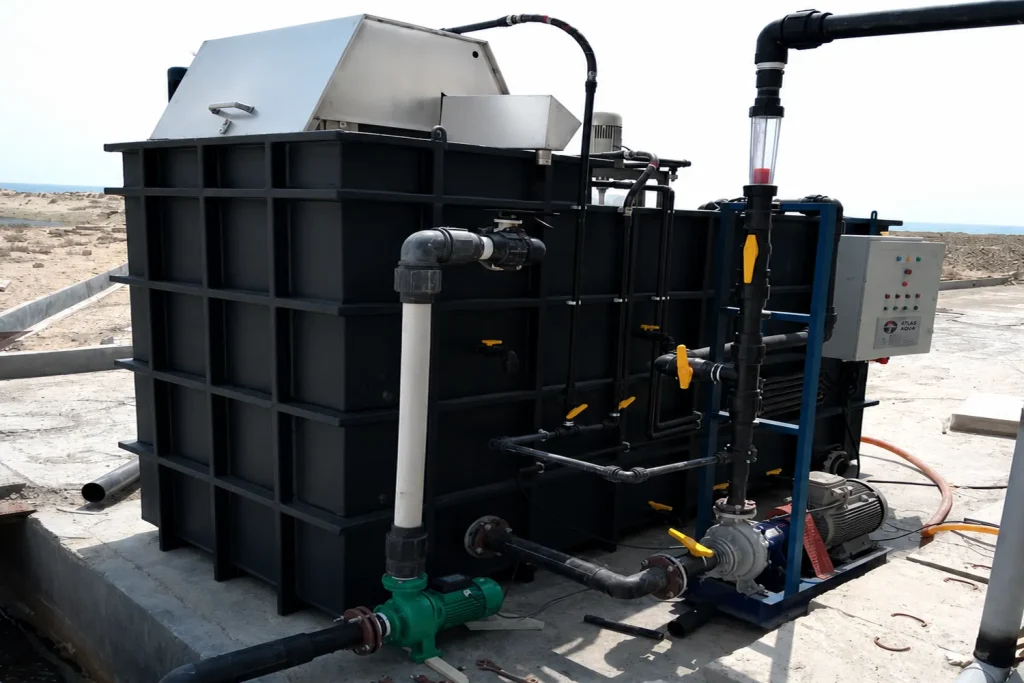
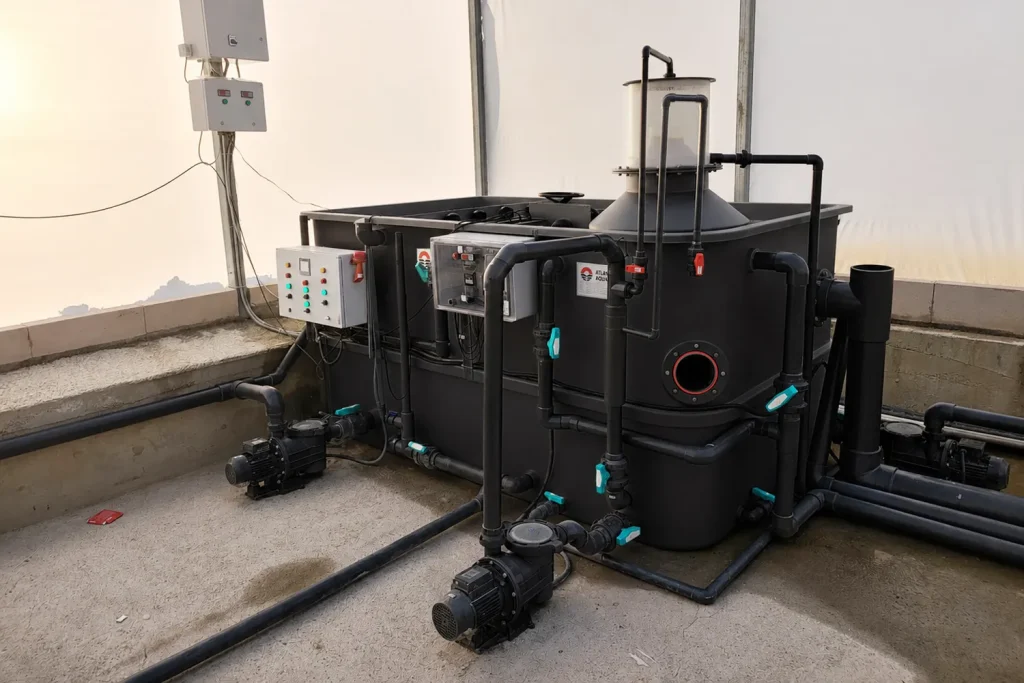
The main stages of RAS water treatment
- Production tanks and hydraulic collection: Water movement carries faeces, uneaten feed and metabolic waste toward the tank outlet. Tank geometry and bottom drainage should remove solids quickly before they disintegrate.
- Mechanical filtration: A drum filter or another micron-rated mechanical filter removes suspended solids. Early separation reduces secondary oxygen demand and protects the biological stage.
- Biological filtration: Nitrifying bacteria in the biofilter convert total ammonia nitrogen first to nitrite and then to nitrate. Capacity must be based on maximum daily feed and TAN load, not simply on tank volume.
- Gas control: Fish and bacteria generate carbon dioxide. A correctly sized degasser helps remove CO₂ and other unwanted dissolved gases, supporting pH stability and efficient oxygen use.
- Oxygenation: Air or pure oxygen is added to the water. High-density projects may use an oxygen cone or NANOB. Oxygen capacity must cover feeding peaks and biological treatment demand as well as standing biomass.
- Disinfection and polishing: A UV filter forms a barrier against free-circulating microorganisms. In marine systems, a protein skimmer may support the removal of dissolved and fine organic matter.
- Monitoring and return: Temperature, pH, dissolved oxygen, water level, flow and equipment status are monitored. Treated water returns to the fish tanks at the required flow and oxygen concentration.
Why must the components be sized together?
The real capacity of a RAS line is limited by its weakest process stage. An adequate drum filter cannot prevent TAN from rising if the biofilter cannot process the feed load. A large biofilter cannot protect fish when CO₂ removal is insufficient. Even the correct pump model will underperform if pipe losses, fouling or hydraulic levels reduce actual flow.
Read more about: Recirculating Fish Farm Setup Cost: The Technical Factors Behind the Price
Engineering principle: Check every component against maximum feed day, actual hydraulic loading, remaining capacity during maintenance and the defined failure scenario.
Where does RAS-BOX fit in the process?
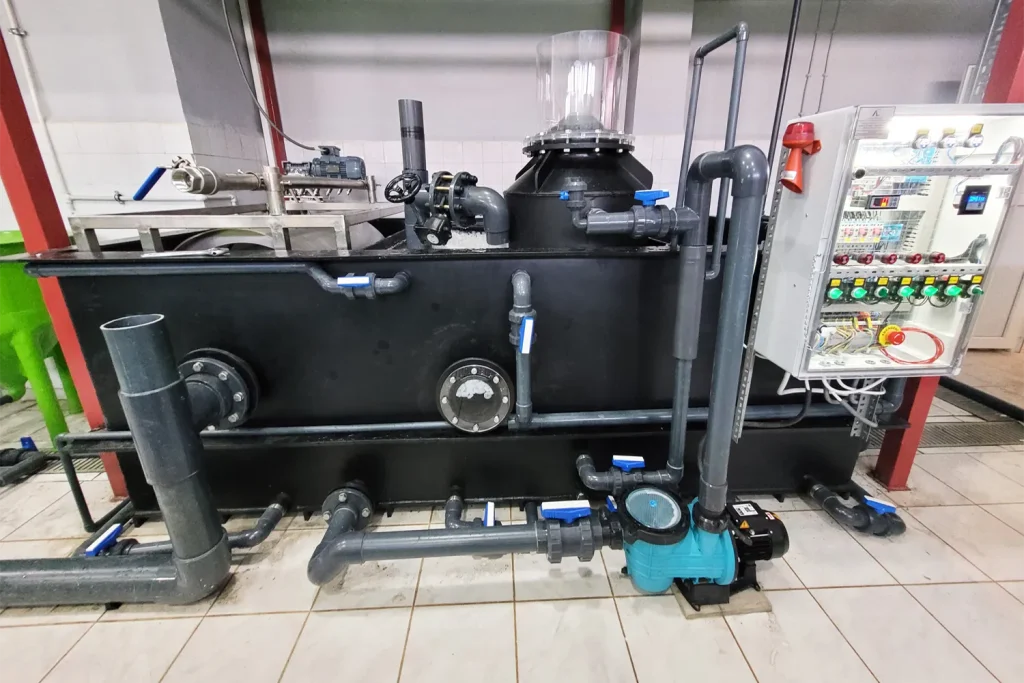
Atlas Aqua RAS-BOX is an integrated water-treatment centre that can combine mechanical filtration, biological treatment, circulation, gas management, UV and control components inside a compact PE100 body. Production tanks remain outside the RAS-BOX; the unit treats water received from those tanks and prepares it for reuse. This distinction is important for correct system positioning and capacity calculation.

Operating indicators that require continuous attention
|
Indicator
|
Why it matters
|
|---|---|
Common design and operating mistakes
- Selecting the system only from tank volume and ignoring maximum feed and waste load.
- Allowing solids to break down before removal and imposing avoidable organic load on the biofilter.
- Assuming that the presence of aeration automatically solves CO₂ removal.
- Treating the pump nameplate flow as actual site flow without measuring pipe, valve and elevation losses.
- Omitting standby pumps, blowers, emergency oxygen and generator scenarios.
- Applying a standard system to different source waters without a complete water analysis.
Read more about: Energy Efficiency, Redundancy and Emergency Design in RAS
Frequently asked questions
Is a RAS completely waterless or zero-discharge?
No. RAS can reduce water use substantially, but sludge discharge, backwashing, evaporation and dissolved-solids control still require make-up water. Zero liquid discharge is a separate advanced-treatment scope.
Do all RAS projects use the same equipment sequence?
The core logic is similar, but species, salinity, temperature, feed load, space and discharge conditions can change the order, bypasses and side-stream treatment.
Read more about: RAS Design by Fish Species: Trout, Carp, Sturgeon and Tilapia
Is a drum filter alone sufficient for a RAS?
No. It removes solids; ammonia conversion, gas control, oxygenation and biosecurity require additional processes.
Can RAS capacity be determined from tank volume?
Not by tank volume alone. Tank volume and stocking density describe biomass, while feed, TAN, oxygen and solids loads primarily determine treatment capacity.
FOR YOUR PROJECT: To develop a balanced RAS process for your fish species, annual production target and source water, Contact Atlas Aqua.