
Water Quality Management in RAS: DO, pH, TAN, Nitrite, Nitrate and CO₂
Water quality in RAS is a network of interacting processes. Temperature and pH control the toxic NH₃ fraction of TAN; alkalinity supports biofilter pH stability; CO₂ affects oxygen use; and solids increase microbial oxygen demand and disease pressure.
Why is water quality central to RAS?
In intensive production, fish, feed and the biofilter continuously consume oxygen and generate metabolites in the same water. A flow-through facility can export much of that load with new water; in a RAS, treatment must keep pace with production. Measurement is therefore a direct part of capacity and operating management—not merely a laboratory check.
Read more about: RAS Design by Fish Species: Trout, Carp, Sturgeon and Tilapia
Targets must be set for the fish species, life stage, temperature, salinity and operating policy. One generic table of ‘ideal values’ found online should not be applied to every RAS project.
Read more about: How Does a RAS System Work? Water-Treatment Stages and Process Flow
Dissolved oxygen (DO)
DO is one of the fastest-changing critical parameters. Fish respiration, post-feeding metabolism, biofilter nitrification and organic degradation all consume oxygen. A high tank-inlet value is not sufficient; the minimum tank-outlet value and the system response during feeding peaks must be monitored.
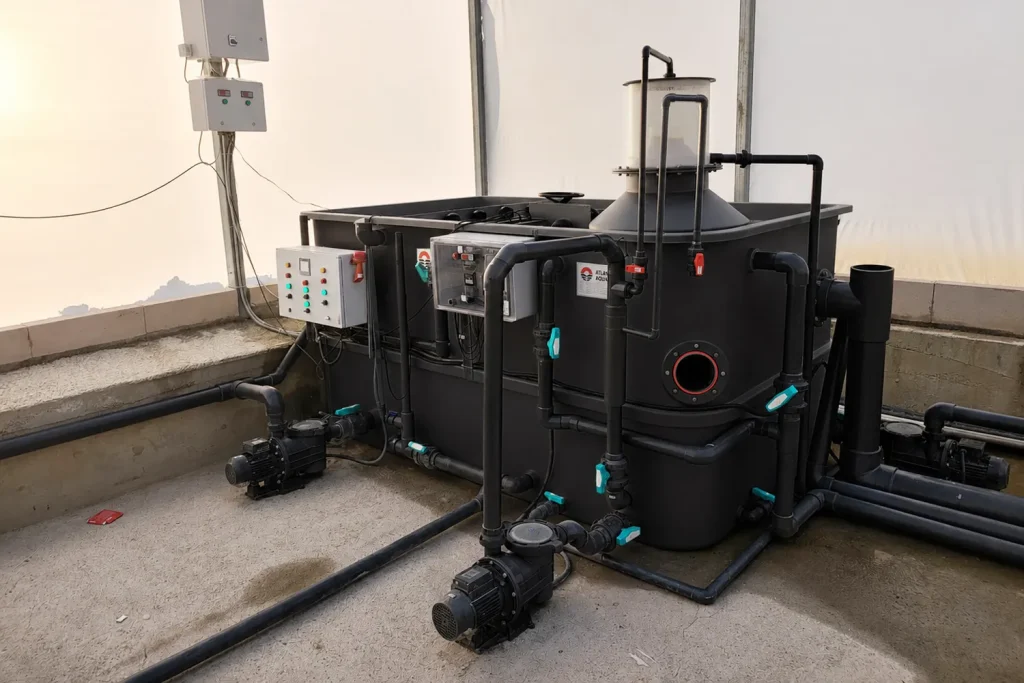
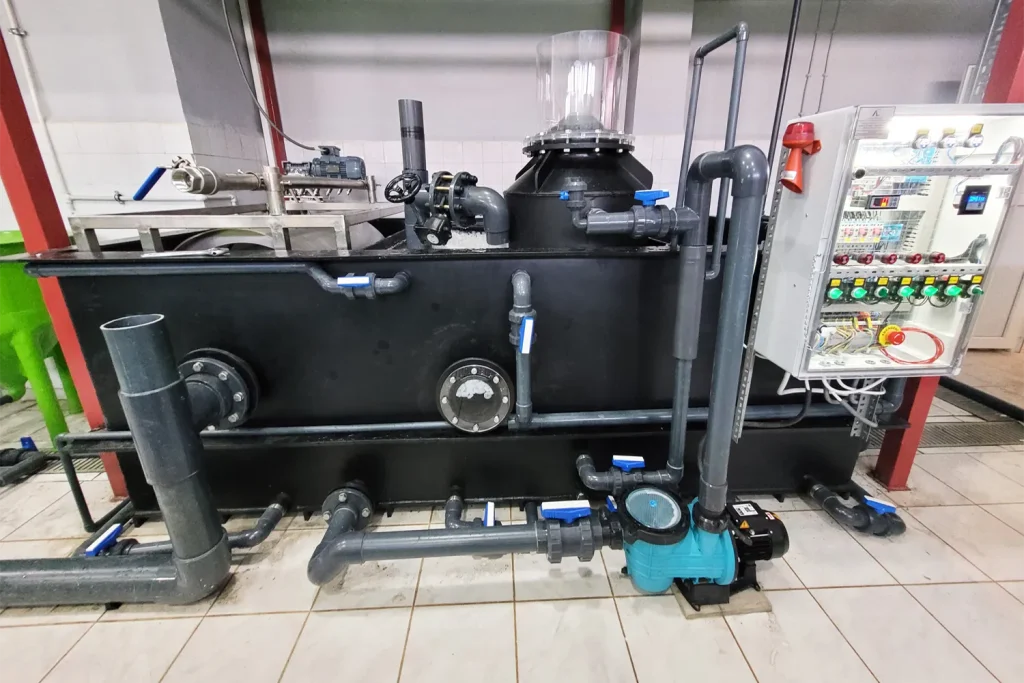
At high densities, pure-oxygen transfer may use an oxygen cone or NANOB. Selection must be based on water flow, inlet/outlet DO difference, pressure and verified transfer efficiency—not the target gas dose alone.
pH and alkalinity
pH affects fish physiology, biofilter activity and the NH₃/NH₄⁺ balance. Nitrification consumes alkalinity and tends to lower pH. Alkalinity trend should therefore be monitored alongside pH, and buffering chemicals should be dosed in a controlled and recorded manner.
Critical relationship: At the same TAN concentration, increasing temperature and pH can increase the toxic unionised-ammonia (NH₃) fraction.
TAN and ammonia
TAN is the sum of ionised NH₄⁺ and unionised NH₃. Part of the nitrogen in feed enters the water as TAN. Its trend must be interpreted with feed input, biofilter capacity, biofilm maturity, temperature, pH, alkalinity and DO.
A TAN increase does not automatically mean that the biofilter is undersized. A sudden feed increase, low alkalinity, low DO, chemical exposure, biofilm loss or reduced actual flow can create the same result.
Read more about: How to Size a RAS Project: Feed Load, Biomass, TAN and Flow Calculations
Nitrite and nitrate
Nitrite is an intermediate product of nitrification and can impair oxygen transport in fish blood. New-system start-up, sudden loading or biofilter imbalance may raise nitrite. The chloride-to-nitrite relationship and species tolerance should be assessed by an aquaculture specialist.
Nitrate is generally less acutely toxic than TAN or nitrite, but it accumulates in intensive RAS. Control may use make-up-water exchange, denitrification, production strategy or integrated plant systems. The operating limit must be species- and life-stage-specific.
Carbon dioxide (CO₂)
Fish, the biofilter and waterborne microorganisms produce CO₂ through respiration. High CO₂ can challenge oxygen transport and use and can affect pH. Fish gathering at the tank inlet or showing abnormal respiration despite apparently normal DO should trigger investigation of CO₂ and overall gas balance.
A degasser must be sized for water-air contact area, air flow, water distribution and hydraulic loading. The presence of a blower alone does not demonstrate effective degassing.
Solids, turbidity and organic load
Faeces and uneaten feed should be removed before disintegration. A drum filter separates solids early, reducing heterotrophic bacterial pressure, oxygen consumption and fine-particle formation in the biofilter. In seawater systems, a protein skimmer can assist with dissolved and fine organic matter.
Temperature, salinity and disinfection
Temperature changes fish growth and oxygen demand, water oxygen-carrying capacity and bacterial reaction rate. Salinity affects oxygen solubility, nitrite toxicity and material selection. Freshwater and marine RAS should not automatically use the same equipment materials or chemical-control approach.
Read more about: Recirculating Fish Farm Setup Cost: The Technical Factors Behind the Price
UV disinfection is a barrier that reduces free-circulating microorganisms. Performance depends on water transmittance, turbidity, UV dose, actual flow and lamp/sleeve maintenance. UV does not replace quarantine, hygiene or veterinary programmes.
How should a monitoring plan be structured?
|
Monitoring level
|
Example parameters and purpose
|
|---|---|
Read more about: Energy Efficiency, Redundancy and Emergency Design in RAS
Monitoring principle: A sensor is not enough. Define its location, calibration interval, alarm threshold, responsible person and the action required after an alarm.
Frequently asked questions
What is the most important RAS water-quality parameter?
DO is often the fastest-changing critical parameter, but it is not sufficient alone. CO₂, TAN, nitrite, pH, alkalinity, temperature and flow must be managed together.
Why can fish be stressed when TAN is normal?
Possible causes include low DO, high CO₂, nitrite, temperature, suspended solids, gas supersaturation or disease.
Does falling pH prove that the biofilter is working?
Nitrification consumes alkalinity and can lower pH, but source water, CO₂ and chemical dosing also affect it. Interpret pH with TAN, nitrite and alkalinity.
Does UV prevent every disease?
No. UV only reduces free microorganisms that pass through the unit at the required dose. Quarantine, hygiene, stock management and veterinary oversight remain necessary.
FOR YOUR PROJECT: To design species-specific water-quality targets, sensor points, alarm thresholds and treatment capacity, Contact Atlas Aqua.