
Recirculating Fish Farm Setup Cost: The Technical Factors Behind the Price
RAS investment cost cannot be estimated reliably from one price per tonne. Projects with the same annual output may require very different equipment and operating budgets because of species, harvest weight, temperature, maximum feed load, automation, redundancy, building scope and local infrastructure.
Why is it difficult to state one RAS price?
A recirculating fish farm is an industrial facility in which production tanks, water treatment, oxygen, temperature control, piping, electricity, automation, the building and the biological production plan must operate together. Two projects targeting the same annual tonnage can have different simultaneous biomass, growth cycles and risk tolerance.
The first budget should therefore be a clearly scoped pre-feasibility estimate. If equipment-supply items are not separated from site, building and owner-supplied works, an apparently low quotation can generate substantial additional costs later.

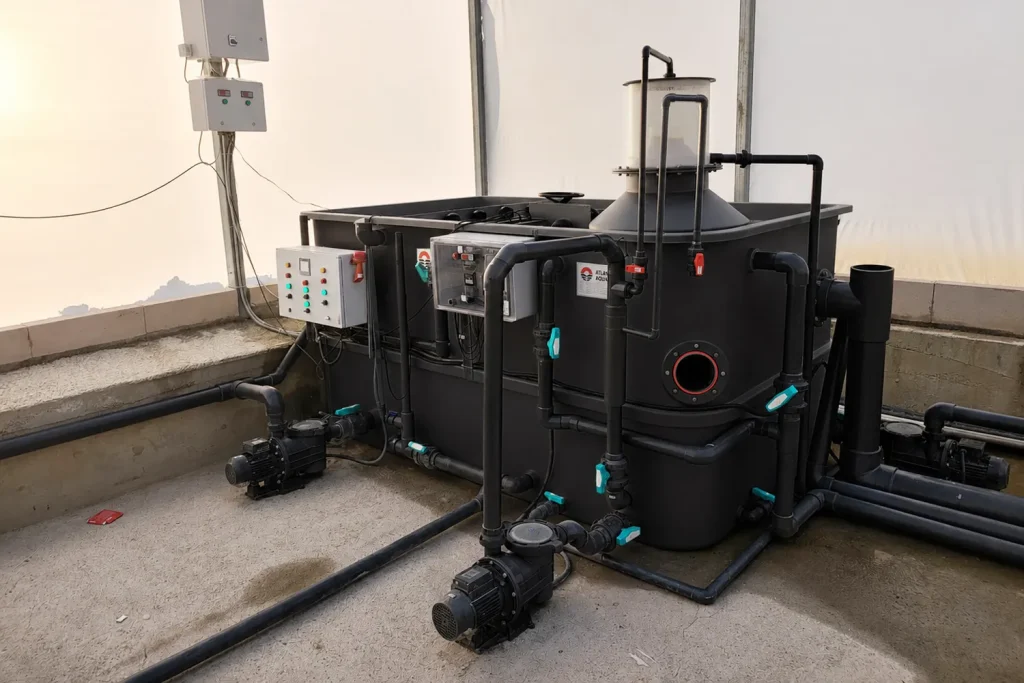
Main technical factors that determine investment cost
- Fish species and operating temperature: Cold-water species may require cooling and high oxygen capacity; warm-water species may require heating and building insulation.
- Production schedule and maximum feed: Treatment is selected for the highest daily feed and waste load, not the annual average.
- Tank volume and geometry: Tank count, diameter, depth, bottom drainage, grading and harvest layout affect both equipment and building area.
- Mechanical and biological filtration: Drum-filter flow and micron rating, biofilter volume and media quantity are major capital items.
- Oxygen, CO₂ and temperature control: An oxygen cone, NANOB, degasser, chiller, boiler or heat pump is selected to match project conditions.
- Disinfection and source-water treatment: UV, ozone, a protein skimmer, source-water filtration or gas removal may be required.
- Automation and redundancy: Sensors, PLC/HMI, remote monitoring, alarms, generator, standby pump/blower and emergency oxygen increase initial cost but reduce the risk of biological loss.
- Building and site works: Floor loading, drainage, insulation, ventilation, electrical infrastructure, clean/dirty zoning and logistics routes can represent a major share of the total budget.
A cheaper pump with poor efficiency may create higher electricity cost for years. Omitting redundancy may reduce the first quotation but expose the entire stock to a short critical failure. Quotations should therefore be compared on lifecycle cost and risk, not purchase price alone.
Compact RAS-BOX or a project-specific central RAS?
RAS-BOX combines mechanical and biological treatment components in a compact PE100 body at standardisable capacities, potentially reducing manufacturing, installation and commissioning time. Modular expansion can suit small and medium facilities or independent production lines.
A central or hybrid RAS may be more appropriate for large output, multiple life stages, special temperature conditions or marine water. The economic choice must consider footprint, energy, maintenance, future expansion and the biomass exposed to a single failure—not initial price alone.
Information required for a useful preliminary quotation
- Project country and city, building status and available footprint
- Fish species, system-entry weight and target harvest weight
- Annual production target and planned batches or harvests
- Source-water analysis, temperature range and available flow
- Electricity tariff, grid capacity and generator availability
- Automation, remote monitoring and redundancy expectations
- Supply scope: equipment only, installation, commissioning, training, building or turnkey delivery
- Feasibility inputs such as sale price, feed cost and juvenile cost
Frequently asked questions
How much does a 100-tonne-per-year RAS facility cost?
Annual tonnage alone is not enough. Species, stocking and harvest weights, simultaneous biomass, feed load, temperature, building, automation and redundancy must be defined before a reliable price can be prepared.
Is equipment always the largest cost?
It depends on the project. Equipment, building, tanks, temperature control, electrical infrastructure and working capital must be assessed together.
Why can the cheapest quotation become more expensive?
Missing scope, poor energy efficiency, inadequate redundancy, low actual flow or building and automation items added later can raise total cost.
What is the difference between pre-feasibility and a firm quotation?
Pre-feasibility provides approximate capacity and a budget range. A firm quotation follows source-water analysis, site review, production modelling, process calculations and a defined supply boundary.
FOR YOUR PROJECT: To prepare a clearly scoped RAS pre-feasibility study comparing energy and production scenarios, Contact Atlas Aqua.