
Energy Efficiency, Redundancy and Emergency Design in RAS
Energy efficiency in RAS is not simply selecting low-power motors. It requires minimising unnecessary lift and pipe loss, choosing equipment at the real duty point and detecting performance decline caused by fouling. Redundancy is not an accessory; it is a primary layer of live-stock protection.
Read more about: How Does a RAS System Work? Water-Treatment Stages and Process Flow
Which RAS processes consume energy?
Major consumers include recirculation pumps, blowers, oxygen supply or transfer systems, heating and cooling, UV, ozone, drum-filter backwash and building ventilation. The largest share varies by project. A tilapia facility in a cold climate and a trout facility with naturally cold source water do not have the same energy profile.
Energy analysis should not stop at installed kW. Track each device’s actual operating hours, load factor, seasonal behaviour and contribution to kWh per kilogram of fish produced.
Read more about: How to Size a RAS Project: Feed Load, Biomass, TAN and Flow Calculations

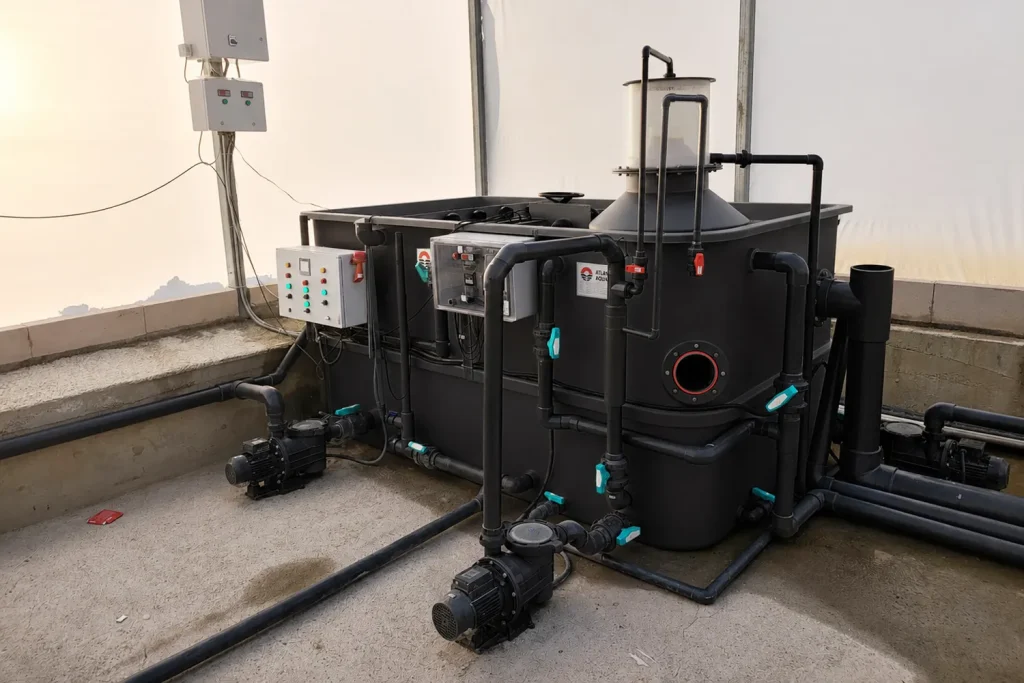
Low-lift pumping design
Core relationship: Pump power rises with flow and total dynamic head and increases as pump-motor efficiency falls. Every unnecessary metre of lift or friction becomes a continuous operating cost.
Where possible, water-treatment units should be arranged at compatible elevations, gravity flow should be used and water should be lifted only as high as the process requires. Pipe diameter, elbows, valve type, manifold geometry and fouling losses determine total dynamic head.
A variable-frequency drive does not automatically save energy. The pump curve, system curve and minimum process flow must be evaluated together. Reducing speed must not compromise tank solids transport, biofilter loading or oxygen balance.
The energy effect of mechanical filtration and maintenance
A blocked screen, pipe or media retainer changes the pump duty point and disrupts hydraulic levels. Drum-filter backwash frequency affects both water use and head loss. Record differential level, actual flow and wash duration.
Blower, degassing and oxygen efficiency
Blower pressure is determined by water depth, diffuser loss and piping resistance. Selecting unnecessarily high pressure and throttling the air wastes energy. Balance the lines, keep diffusers clean and measure actual air flow.
For CO₂ removal, degasser water distribution and air-to-water ratio are critical. Pure-oxygen applications using an oxygen cone or NANOB should be evaluated by actual transfer efficiency. Oxygen escaping unused is both a gas cost and a sign of poor process control.
Reducing heating and cooling load
Building insulation, tank and pipe surfaces, make-up-water temperature, ventilation, humidity control and heat recovery must be considered together. Efficient treatment equipment cannot compensate for an uninsulated building or an unnecessarily high make-up-water ratio. Matching species to climate and source-water temperature is fundamental to feasibility.
Redundancy design: what does N+1 mean?
N+1 means one independent standby unit in addition to the number required for normal operation. Keeping a spare in storage is not enough. Hydraulic and electrical connections must be ready, transfer must be automatic or rapid, and the standby equipment must be tested regularly.
Read more about: Recirculating Fish Farm Setup Cost: The Technical Factors Behind the Price
|
Critical process
|
Recommended protection
|
|---|---|
Emergency scenarios must be written and tested
- Grid power fails: Verify generator start time, emergency-oxygen activation and notification of responsible personnel.
- Main pump stops: Start the standby pump automatically or manually and verify check-valve and isolation-valve positions.
- DO falls rapidly: Stop feeding, activate emergency oxygen, and check DO and fish behaviour tank by tank.
- Biofilter blower stops: Restore air; adjust feeding and monitor TAN/nitrite according to outage duration.
- Water loss or overflow occurs: Isolate the affected line, prevent dry running and replace lost water under control.
- Sensor or communications fail: Verify with a portable instrument and switch to the documented local-manual procedure.
Energy and safety KPIs
- Total kWh/kg fish and energy distribution by process
- Pump power per actual flow (kW and m³/h)
- kg oxygen/kg feed and minimum tank-outlet DO
- Drum-filter backwash water and wash-cycle frequency
- Monthly generator and standby-pump test success
- Time from alarm to operator intervention
- Unplanned downtime outside scheduled maintenance
Frequently asked questions
Is RAS electricity use fixed per tonne?
No. Species, temperature, pumping head, make-up-water ratio, oxygen system, building and capacity utilisation all change consumption.
Does a variable-speed pump always save energy?
No. Reducing speed without the system curve and minimum process flow can impair water quality or move the pump into an inefficient operating region.
Is emergency oxygen still needed when a generator is installed?
In most intensive systems, yes. Emergency oxygen provides an independent safety layer during generator start-up delay or generator failure.
Can the standby pump remain in storage?
On critical RAS lines, a connected, valved and tested standby pump reduces response time. A spare in storage may not reduce biological risk sufficiently.
FOR YOUR PROJECT: For a RAS with measurable energy use, redundant critical processes and defined alarm scenarios, Contact Atlas Aqua.